
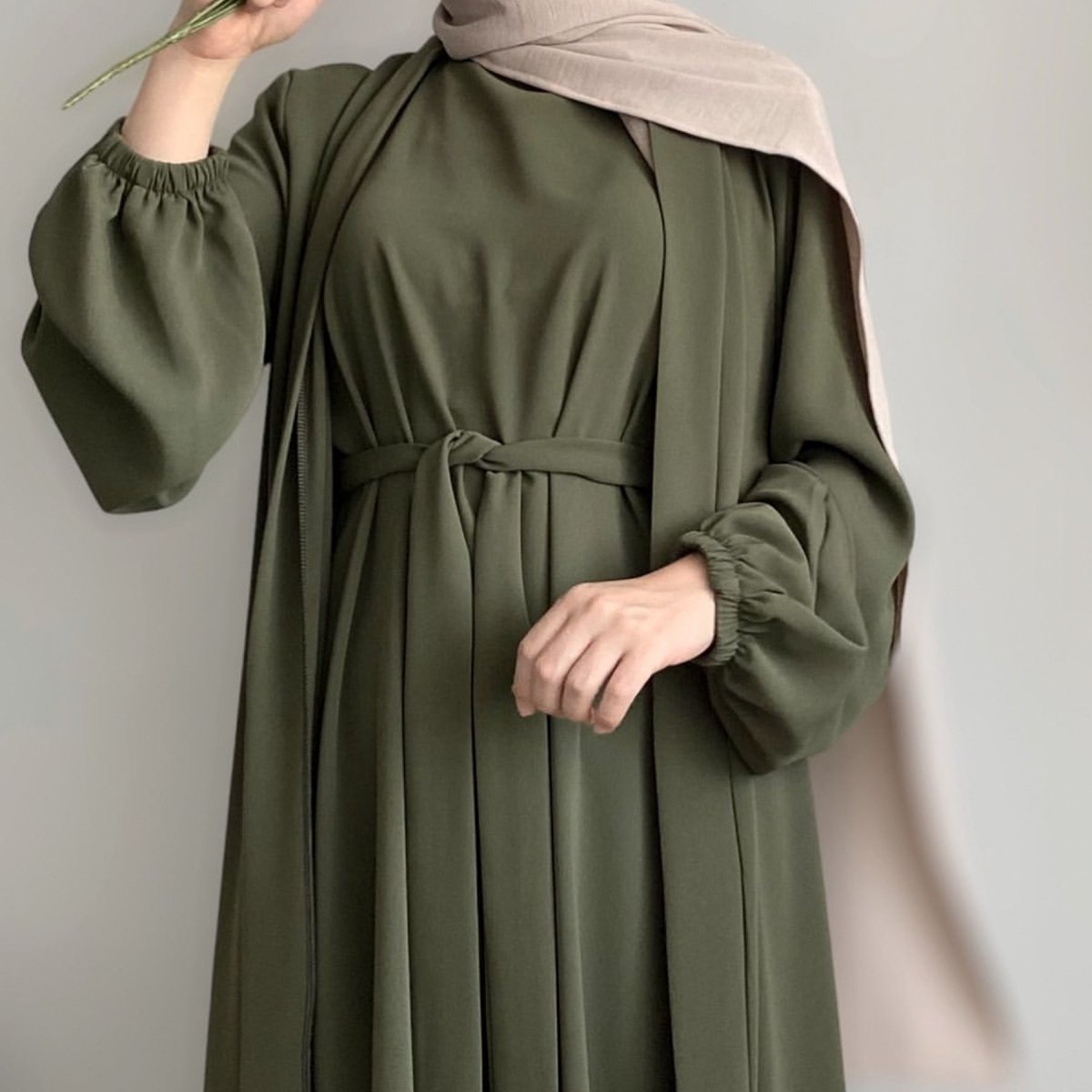
By NEEIM Styling Studio
The correct underlayer should complete an abaya without competing with it. It must provide the required coverage, regulate temperature, preserve the outer garment’s drape, and remain visually controlled wherever it becomes visible.
Quick answer: what should you wear under an abaya?
| Abaya type | Best underlayer | Primary purpose | Avoid |
|---|---|---|---|
| Closed everyday abaya | Lightweight slip dress, smooth long dress, or breathable top with straight trousers | Coverage without visible bulk | Thick waistbands, cargo pockets, and raised ribbing |
| Open abaya | Coordinating inner dress, column dress, or tonal top-and-trouser set | Creates a finished visible base | Unstable necklines, mismatched hems, and casual sleepwear-style layers |
| Butterfly or batwing abaya | Narrow inner dress or streamlined separates | Balances the volume of the outer silhouette | Oversized garments beneath an already voluminous cut |
| White or pale abaya | Matte, opaque, low-contrast neutral underlayer | Reduces show-through and visible outlines | Bright white or black without a daylight test |
| Embellished occasion abaya | Minimal inner dress with a smooth surface | Keeps attention on embroidery, crystals, or satin detailing | Ruffles, appliqué, heavy shine, and exposed hardware |
| Summer abaya | One thin, opaque, breathable base | Controls heat while maintaining coverage | Several partial layers stacked together |
| Winter abaya | Fine thermal base with slim trousers or a lined inner dress | Adds insulation without changing the silhouette | Heavy knitwear forced beneath narrow sleeves |
The best general solution is the lightest smooth layer that provides sufficient opacity and remains stable during movement. Under a closed abaya, the base can remain visually quiet. Under an open abaya, it must function as a complete outfit.
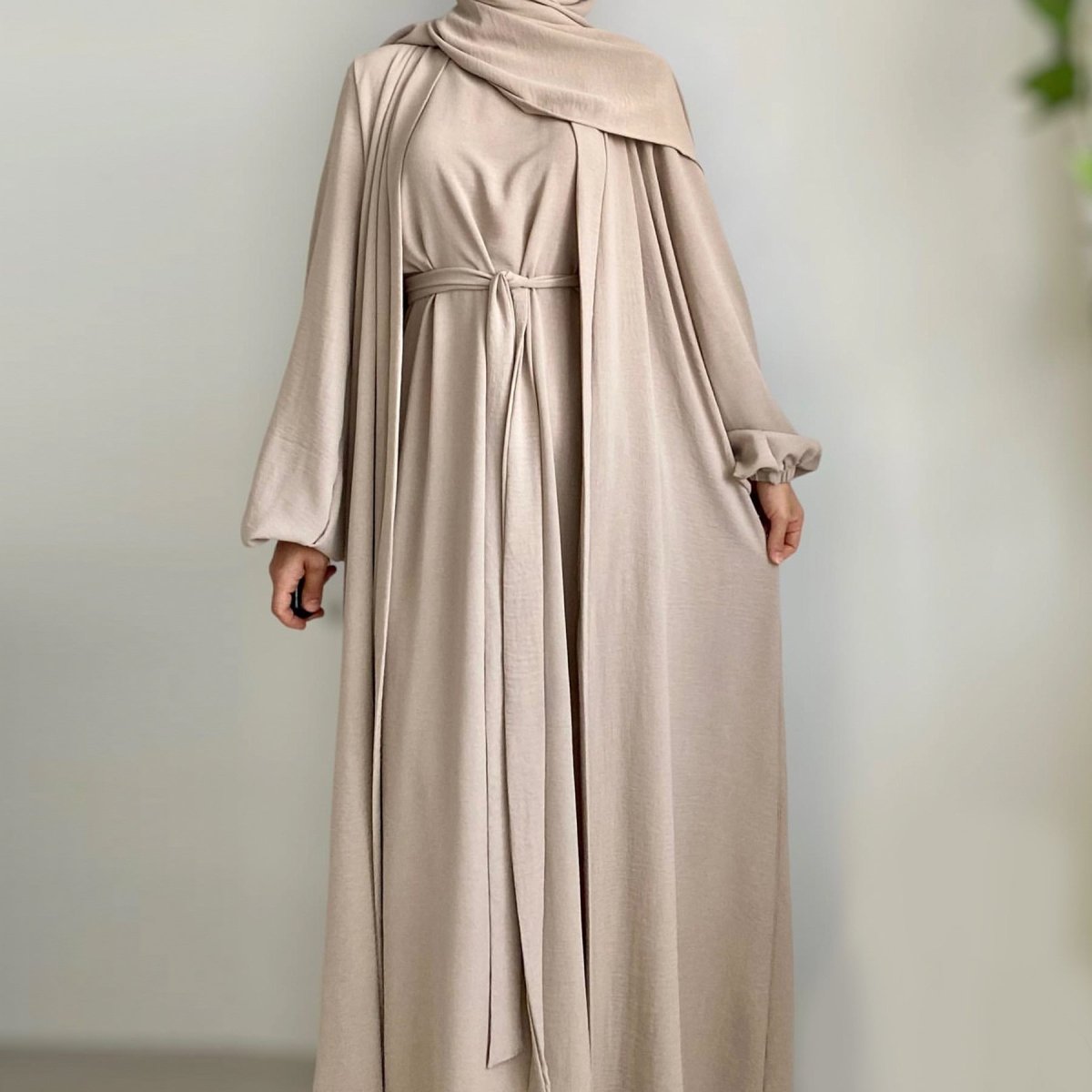
The four-function underlayer profile
Every underlayer should be assessed against four functions: coverage, thermal comfort, friction control, and visible styling. A garment that performs well in only one category can still fail as part of the complete outfit.
In NEEIM Styling Studio fittings, we evaluate the abaya and base layer as one moving system. Show-through, twisting, sleeve compression, heat buildup, and hem interference usually appear only after the wearer walks, sits, reaches, and turns.
1. Coverage
Coverage must be evaluated during movement, not only while standing still. An abaya can become more revealing when the front opens while walking, a side slit separates while entering a car, wide sleeves rise with the arms, pale fabric stretches across the knees, or the outer layer shifts in wind.
The underlayer must complete the coverage architecture of the entire outfit.
2. Thermal comfort
Fiber names alone do not determine whether an underlayer will feel cool or warm. Fabric weight, thickness, knit or weave density, air permeability, moisture movement, drying behavior, surface finish, and the space between layers all affect comfort.
The strongest summer base is usually the thinnest non-sheer garment that remains dry, stable, and comfortable beneath the specific abaya. The strongest winter system is usually a sequence of thin, smooth layers rather than one bulky knit.
3. Friction and static
The abaya and underlayer should move independently without catching. Common failures include the outer garment twisting around the legs, gathering near the hips, bunching at the elbow, clinging after several steps, or rising unevenly at the hem.
Raised seams, coarse ribbing, dry fabric surfaces, and incompatible synthetic combinations can increase resistance between layers. For fluid Nida, crepe, and satin-finished abayas, a smoother underlayer usually produces a cleaner fall.
4. Visible styling
A closed abaya can conceal most of the base. An open abaya exposes it as the central visual column of the outfit.
Five details determine whether that base appears intentional: neckline, sleeve, waist, hem, and color relationship. A technically modest underlayer can still look unfinished if those elements are unresolved.
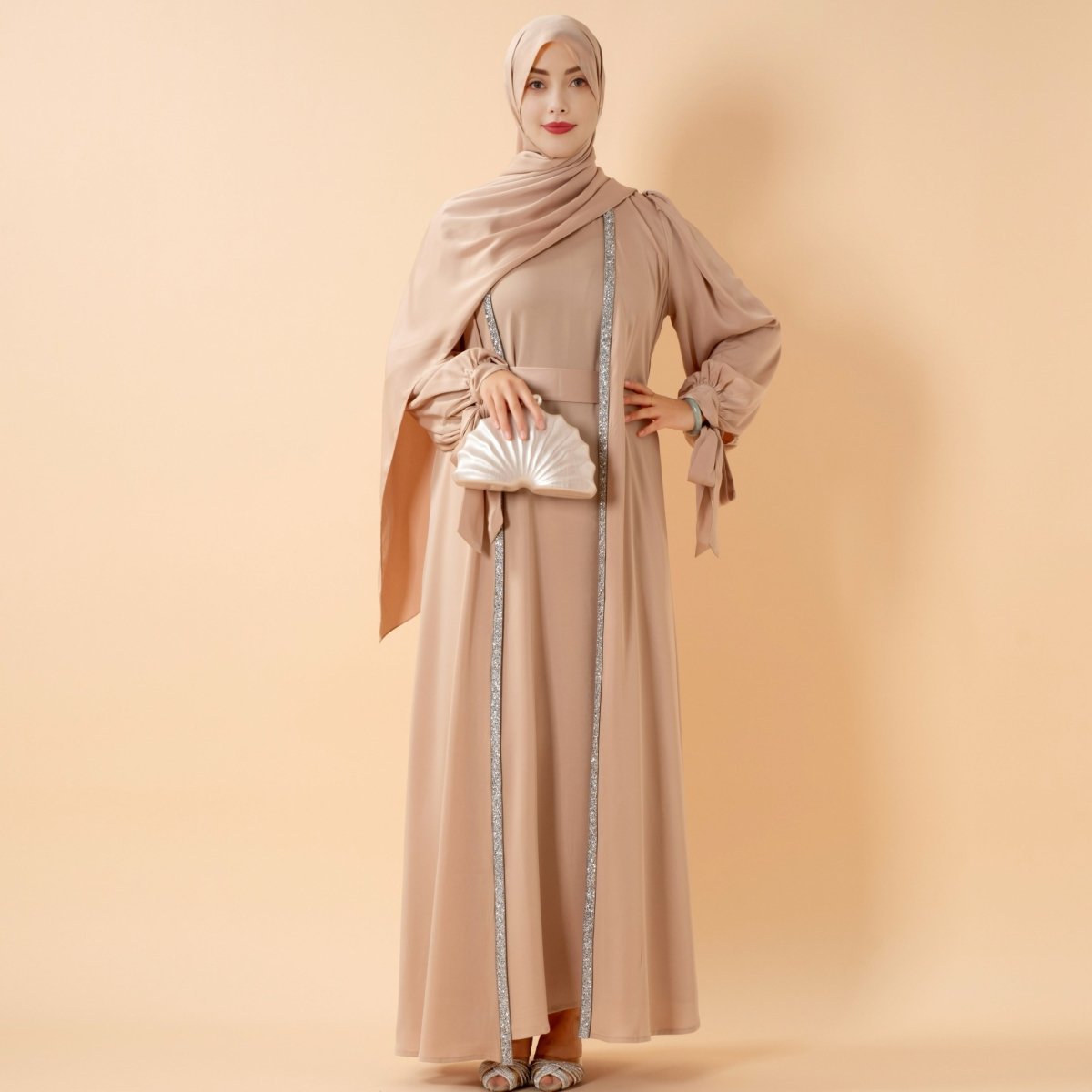
What to wear under each abaya silhouette
Closed everyday abaya
A closed abaya usually requires the simplest base: a lightweight full-length slip, a smooth long dress, a fitted long-sleeve top with straight trousers, or a sleeveless inner dress when the outer sleeves provide secure coverage.
The base should remain narrower than the outer garment. Avoid cargo pockets, thick elastic waistbands, heavy ribbing, gathered skirts, raised embellishment, and multiple overlapping tops. These details may stay hidden, but they can still distort the outer silhouette.
Open abaya
An open abaya frames the underlayer from neckline to hem. The base must therefore be treated as finished clothing rather than hidden clothing.
Strong options include a coordinated inner dress, a monochromatic column dress, a long tunic with straight trousers, a polished top with softly tailored wide-leg trousers, or a sleeveless dress combined with a separate fitted sleeve layer.
The safest color strategy is tonal rather than identical: black with charcoal, espresso with mocha, stone with warm beige, navy with ink blue, or burgundy with deep aubergine. High contrast creates a stronger visual break. Tonal contrast creates a longer, more controlled line.
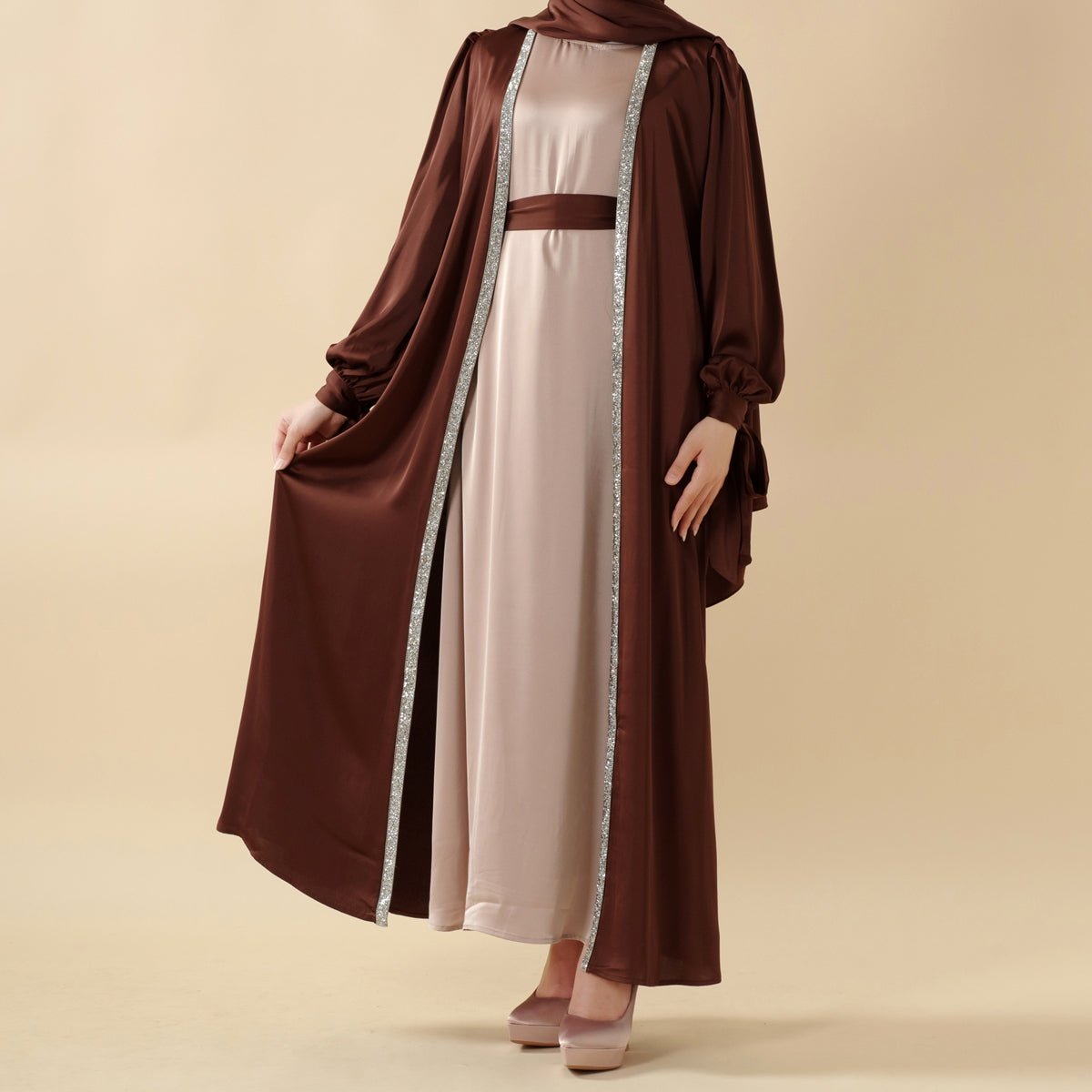
For a complete styling system, read How to Style Tonal and Open Abayas.
Neckline rule
The neckline must remain stable when the outer garment moves. Clean crew, soft mock, controlled round, and restrained square necklines usually perform better than loose necklines that collapse, expose straps, or shift asymmetrically.
Sleeve rule
The inner sleeve must fit inside the outer sleeve without twisting. Use fine fitted sleeves beneath narrow abaya sleeves, smooth long sleeves beneath transparent or wide openings, and sleeveless inner dresses when the outer sleeves provide the required coverage.
Waist rule
The front opening should remain visually uninterrupted. Choose flat waistbands and low-profile closures. Avoid thick drawstrings, large belt knots, cargo pockets, layered peplums, and bulky tucked fabric.
Hem rule
The inner hem should not repeatedly extend beyond the abaya unless the contrast is deliberate. Test the outfit with normal footwear, stairs, a full walking stride, sitting and standing, and the abaya worn both open and belted.
Butterfly and batwing abayas
Butterfly and batwing abayas already carry volume through the sleeves and side body. The underlayer should be narrower.
Choose a straight inner dress, column slip, slim trousers, or a controlled long-sleeve top. Avoid placing an oversized dress beneath an equally oversized outer garment. Two layers with similar volume can bunch at the side seams, widen the silhouette, restrict arm movement, and reduce the floating quality of the abaya.
Kimono-style abayas
A kimono abaya creates a strong vertical frame. Support that line with a monochromatic inner dress, streamlined trouser set, long tunic with minimal side volume, or a tonal top-and-trouser combination.
The waist should remain visually quiet. A contrasting top and trouser combination can work for a casual look, but it creates a horizontal break that reduces the elongated effect.
Embellished and occasion abayas
An embellished abaya requires restraint beneath it. If the outer garment includes embroidery, crystals, satin panels, sculptural cuffs, or dramatic sleeves, choose an inner dress with minimal seams, a smooth surface, controlled sheen, no visible hardware, and no competing ornament.
During occasionwear fittings, check the inner layer against cuffs, closures, and embroidered areas for snagging before assessing the mirror view. The underlayer should support the design rather than compete for attention.
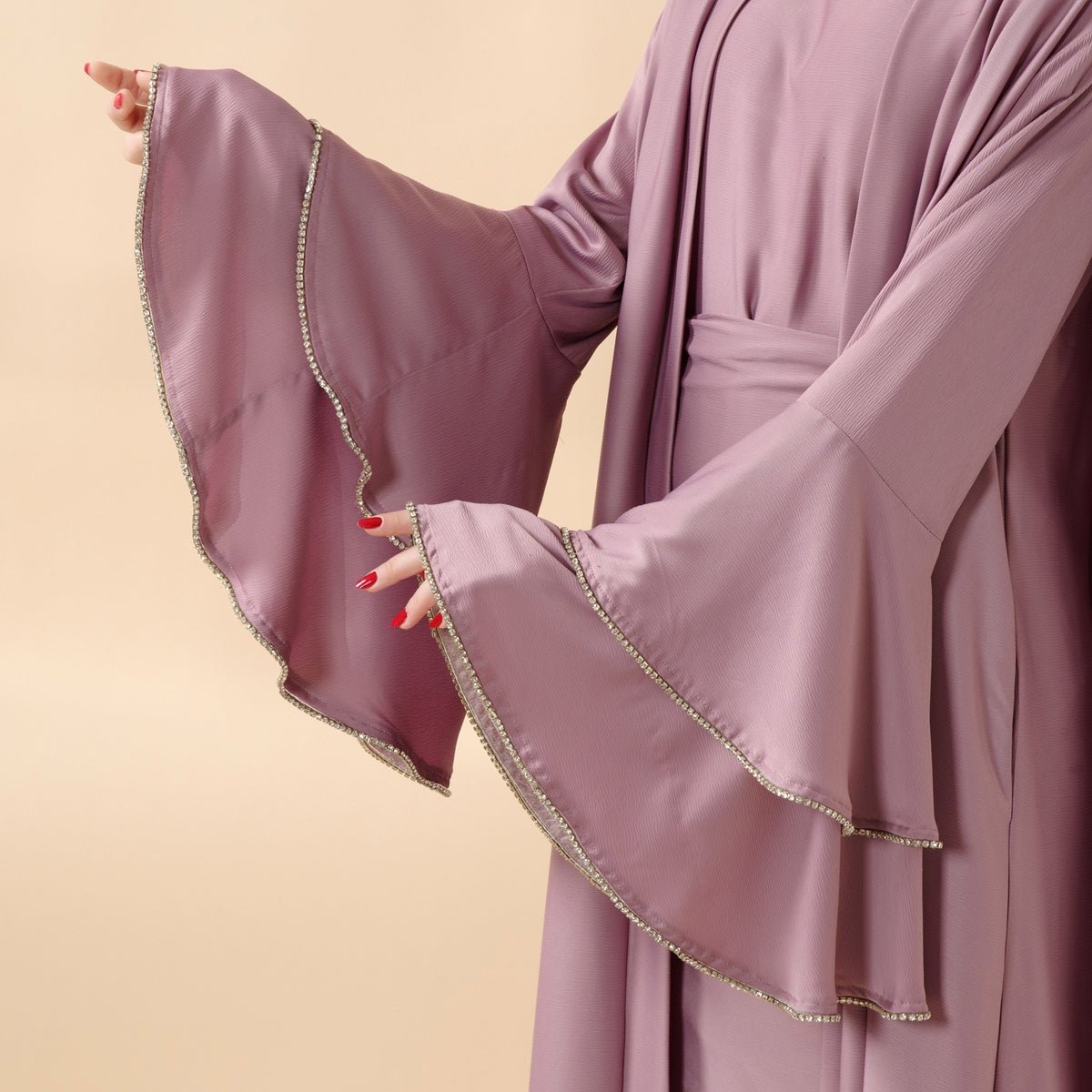
The under-abaya fabric matrix
| Outer abaya fabric | Recommended underlayer | Avoid | Reason |
|---|---|---|---|
| Fluid Nida | Smooth slip, fine jersey column, or clean woven dress | Coarse ribbing and raised seams | Preserves fluid movement |
| Soft crepe | Matte inner dress or streamlined separates | Rough knits and bulky pockets | Reduces catching and rotation |
| Satin or satin-trimmed | Matte, smooth base | Highly reflective satin beneath satin | Prevents excessive shine |
| Lightweight summer fabric | One thin opaque layer | Multiple dresses or heavy leggings | Controls heat and bulk |
| Structured fabric | Fine knit or tailored base with flat seams | Loose garments that fold beneath the structure | Preserves the intended architecture |
| Embroidered fabric | Minimal column dress | Ruffles, beading, and appliqué | Prevents snagging and visual competition |
| Pale or translucent fabric | Low-contrast opaque neutral | Strong black, bright white, or saturated prints without testing | Reduces show-through |
What to wear under a white or light-colored abaya
White under white is not always the least visible solution. A pure white base can appear brighter beneath translucent ivory, cream, or off-white fabric.
The color-depth test
- Place the abaya over the intended underlayer near a window.
- View the outfit from the front and back.
- Check the knees, hips, elbows, and seat.
- Photograph the garment at normal exposure.
- Move the outer fabric across the body.
- Compare several neutral shades.
The best result is the layer that creates the least visible contrast through the abaya. Effective shades may include warm beige, taupe, stone, muted sand, soft brown, or a close tonal match to the outer garment.
The correct shade depends on both the wearer’s skin tone and the undertone of the abaya. Always perform the test in daylight. Indoor mirrors can conceal transparency that becomes visible outdoors.
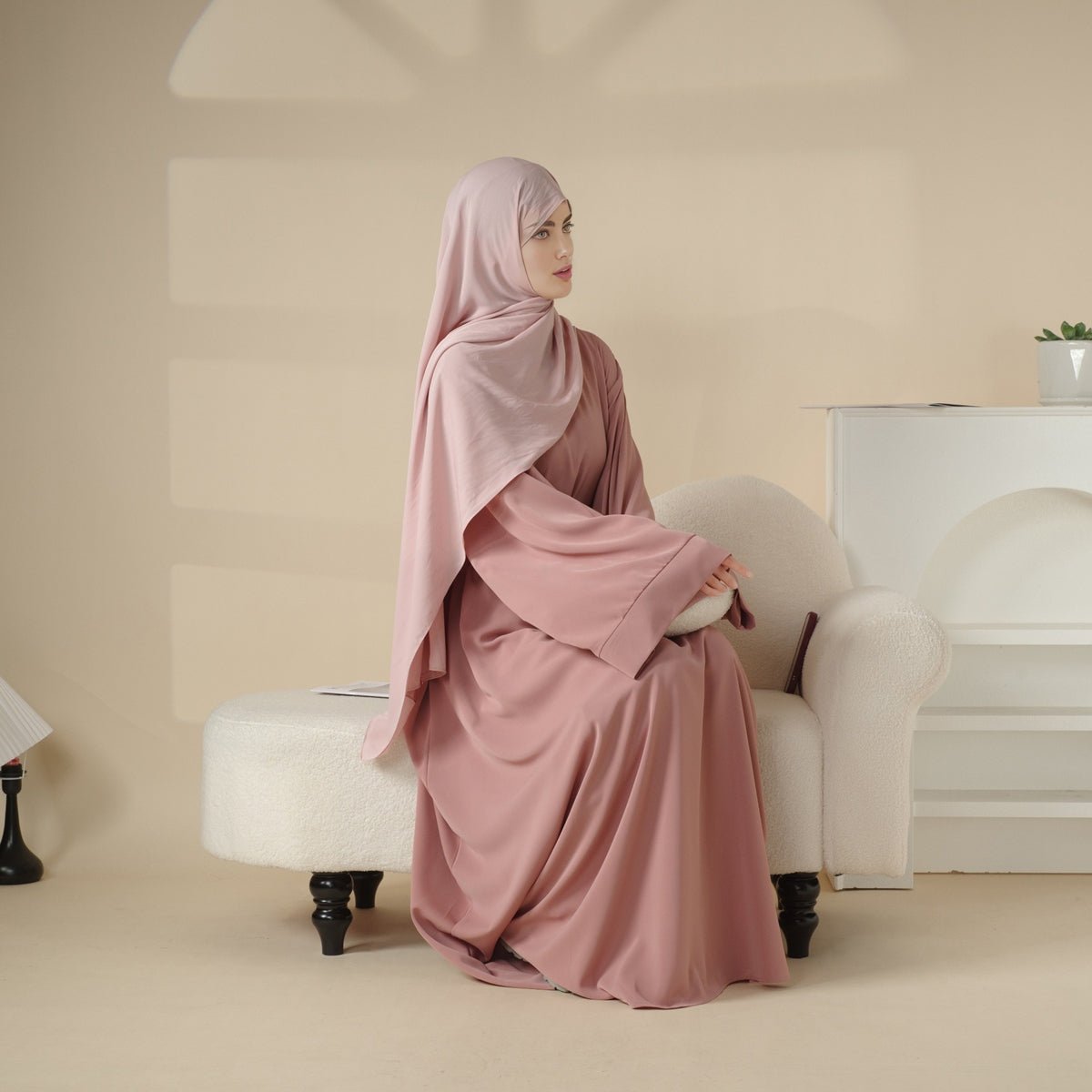
Summer layering under an abaya
In warm weather, every layer must have a defined purpose. Remove any garment that is present only from habit.
- Use one opaque base instead of a sheer dress and separate slip.
- Use a sleeveless inner dress when the abaya sleeves remain secure.
- Add a thin sleeve layer only where additional arm coverage is required.
- Choose flat seams, lightweight fabrics, minimal hardware, and controlled ease.
Avoid extremely tight base garments. A small amount of space between the underlayer and abaya can improve air movement. Excess fabric, however, can trap heat and create tangling.
The objective is controlled ease: close enough to remain smooth, relaxed enough to move.
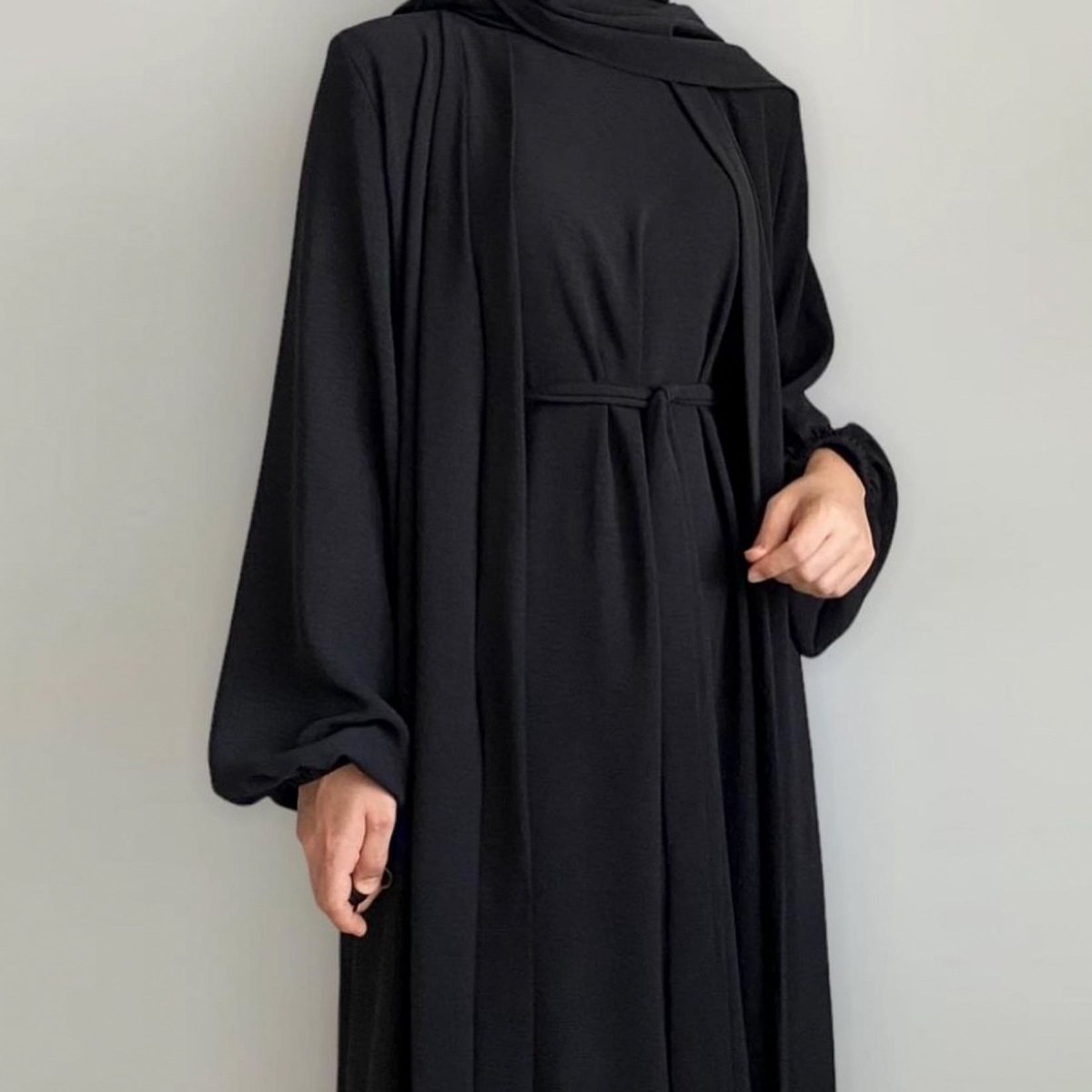
Winter layering under an abaya
Cold-weather layering should be built in thin increments: a fine thermal or smooth long-sleeve base, a slim inner dress or tailored trouser layer, the abaya, and an external coat where necessary.
Avoid forcing thick sweaters beneath narrow shoulders or sleeves. Bulky knitwear can pull across the upper arms, distort the shoulder line, restrict sleeve movement, and create visible ridges through the outer garment.
In many silhouettes, a fine base beneath the abaya and an insulating coat above it preserves the line more effectively than placing all warmth underneath.
Common under-abaya problems
| Problem | Likely cause | Correction |
|---|---|---|
| Abaya clings to the legs | Static, dry air, or incompatible fabric surfaces | Replace one layer with a smoother fabric and test again |
| Outer garment twists while walking | Excess friction or an unstable waistband | Use a smoother base and flat-front waist construction |
| Sleeves bunch at the elbow | Inner sleeve is too loose or textured | Replace it with a finer fitted sleeve |
| Waistline appears bulky | Thick elastic, belt, pockets, or overlapping tops | Use a one-piece inner dress or flat waistband |
| Pale abaya appears transparent | Strong contrast beneath the fabric | Use the daylight color-depth test |
| Inner dress extends below the abaya | Length mismatch, stretch, or different stride behavior | Test with footwear and correct the inner hem |
| Outfit overheats | Too many layers or dense fabric | Replace several partial layers with one opaque base |
| Neckline shifts open | Loose or unstable neckline | Choose a secure neckline or minimal insert |
| Abaya catches at the hips | Raised seams, pockets, or textured fabric | Use a smoother underlayer with fewer construction details |
The six-point NEEIM fitting protocol
Use this protocol with the abaya, underlayer, normal footwear, belt, and hijab if worn. A complete outfit should pass all six checks.
1. Daylight test
Stand near a bright window. Check the front, back, knees, hips, elbows, seat, and side openings for transparency, visible outlines, and changes in color depth.
2. Sit-and-step test
Sit in a chair, stand, and step onto a low stair. Confirm that side slits remain controlled, the underlayer does not ride upward, the inner hem remains stable, and the front opening does not reveal unfinished clothing.
3. Reach test
Reach overhead and forward. Check whether the inner sleeve rises, the neckline moves, the top becomes untucked, or the abaya pulls across the shoulders.
4. Pinch-release test
Pinch the two fabrics together at the hip or thigh. Release them and walk. The abaya should fall back into position without remaining attached to the underlayer.
5. Opening test
For an open abaya, walk toward a mirror and turn. Allow the front panels to separate. Every visible section of the base should appear finished.
6. Ten-minute comfort test
Wear the complete combination indoors for ten minutes. Assess heat, static, seam pressure, waistband rolling, sleeve twisting, neckline movement, and hem interference.
Correct layering also depends on correct dimensions. Use the NEEIM Abaya Size Guide to establish length, ease, and sleeve fit.
A six-piece under-abaya capsule
- Dark column dress: for black, navy, charcoal, and deep jewel-toned abayas.
- Low-contrast neutral inner dress: for cream, beige, taupe, stone, pale grey, and off-white.
- Lightweight full-length slip: for closed abayas that require additional opacity but no visible styling.
- Fine long-sleeve top: for sleeve coverage, temperature changes, and sleeveless inner dresses.
- Flat-front straight trousers: for open abayas, kimono abayas, travel outfits, and long tunics.
- Minimal occasion inner dress: for satin, embroidery, crystals, and sculptural outer layers.
A capsule built within one tonal family produces more combinations and fewer accidental contrasts.
Under-abaya buying checklist
- Is it opaque in daylight?
- Does it remain smooth beneath the intended abaya?
- Are the seams flat?
- Does the neckline remain stable?
- Will the sleeve fit inside the outer sleeve?
- Does the waistband create a visible ridge?
- Does the hem work with your height and footwear?
- Do the fabrics separate after the pinch-release test?
- Can the garment work beneath more than one abaya?
- Are the care instructions suitable for frequent wear?
Coordinated sets reduce uncertainty around color, proportion, and hem placement. Explore Open and Two-Piece Abayas or view the complete NEEIM Abaya Collection.
Frequently asked questions
What should you wear under an abaya?
Wear a smooth slip dress, full-length inner dress, or a polished top-and-trouser base. The correct choice depends on whether the abaya is open or closed, the opacity of the outer fabric, the climate, and how much of the underlayer remains visible.
What should you wear under an open abaya?
Wear a complete visible base such as a coordinated inner dress, a tonal column dress, or a refined top-and-trouser set. The neckline, sleeve, waist, color, and hem should remain controlled when the outer panels move.
What should you wear under a white abaya?
Choose a matte, opaque, low-contrast neutral that works with both your skin tone and the undertone of the abaya. Pure white is not always the least visible option, so test the full outfit in daylight and backlight.
Can you wear leggings under an abaya?
Leggings can work as a hidden base beneath a fully closed, opaque abaya. Beneath an open abaya, they usually need a long tunic or inner dress to create a complete visible outfit.
Is a satin slip suitable under every abaya?
No. Satin can reduce friction beneath some fabrics, but it can increase heat, shine, or static beneath others. Test the exact fabric pairing with movement and the pinch-release method.
How do you stop an abaya from clinging?
Change one of the fabric surfaces, reduce dryness, and choose a smoother base layer. Static cling is often resolved more effectively by replacing an incompatible underlayer than by adding another garment.
Should an inner dress be shorter than the abaya?
The inner dress should not repeatedly extend beyond the outer hem unless the reveal is intentional. Test both garments with normal footwear, stairs, and a full walking stride.
What is best to wear under an abaya in summer?
Choose one lightweight, opaque base with low bulk, comfortable airflow, and effective moisture release. A sleeveless inner dress can reduce heat when the outer sleeves provide the coverage you need.
Can you wear jeans under an open abaya?
Yes. Straight or wide-leg jeans with a clean top can create a structured casual base. Avoid bulky pockets, heavy distressing, and thick waistbands that distort the front opening.
What is the best color to wear under a black abaya?
Black creates the most continuous visual line. Charcoal, espresso, deep navy, and other low-contrast dark tones also work when the objective is tonal depth rather than an exact match.
Final principle
The underlayer should make the abaya easier to wear. It should complete coverage, regulate temperature, preserve movement, and remain visually intentional wherever it becomes visible.
Choose the simplest layer that solves the actual problem. Then test the complete outfit in daylight, during movement, and after the fabrics have been worn together.
Explore the Three-Piece Open Abaya Set, the Bow-Tie Sleeve Abaya Set, and the Nida Abaya and Belt Set.